Digital operating instructions under the Machinery Regulation: What's allowed – and what's not
14.08.2026
J. Ennen
3 Minuten
Table of Contents
Example H2
This is a div block with a Webflow interaction that will be triggered when the heading is in the view.
From January 20, 2027, machine operating instructions may for the first time be provided digitally as a matter of course. This saves printing costs and opens up new possibilities – but only under clear conditions. Anyone who overlooks them risks a formal conformity defect.
For decades, the rule was simple: a machine came with printed operating instructions. Under the old Machinery Directive, paper was effectively mandatory, and purely digital instructions existed in a legal grey area. The new Machinery Regulation (EU) 2023/1230 reverses this and explicitly recognizes digital operating instructions as an acceptable standard form. The catch lies in the details: the regulation ties digitalization to precise requirements, and in two cases paper remains mandatory. This article sets out what is allowed – and what is not.
From a paper obligation to a digital option
The central provision is found in Article 10(7) of the Machinery Regulation: the machine must be accompanied by the instructions and the information referred to in Annex III – and the instructions may be provided in digital form. What may sound today like a minor wording change is in fact a genuine break with decades of practice.
Worth noting for planning purposes: there is no need to wait until 2027 to make the switch. The updated guide to the still-applicable Machinery Directive (as of April 2024) already recognizes the conditions set out in Article 10(7) of the Machinery Regulation – meaning digital operating instructions are already a permissible option today. The Regulation, with all its obligations, becomes binding for everyone from January 20, 2027.
The requirements for digital operating instructions
Anyone providing instructions digitally must meet the following requirements, which follow directly from Article 10(7):
• Clearly indicate access: The machine or product – or, if that is not possible, the packaging or an accompanying document – must state how to access the digital instructions. In practice: a QR code or other machine-readable code, sensibly supplemented by a plain-text URL.
• Usable format: The instructions must be printable, downloadable, and storable on an electronic device, so that the user can access them at any time – explicitly including in the event of a machine failure. This requirement also applies where the instructions are embedded in the machine's software.
• Permanent availability: The instructions must be accessible online for the expected lifetime of the machine, and in any case for at least ten years after it is placed on the market.
• Clear model assignment: The instructions and information must clearly describe the product model to which they correspond – any confusion between variants or versions must be ruled out.
• Correct language: The operating instructions, safety information, and Annex III information must be drawn up in a language determined by the relevant Member State that is easily understood by users – clear, comprehensible, and legible. What matters is the country of destination, not the manufacturer's language.
Where paper remains mandatory
"Digital allowed" does not mean "paper abolished." The Regulation provides for two cases in which printed documentation is still required:
• Paper on request: If a user requests printed instructions at the time of purchase, the manufacturer must provide them in paper form, free of charge, within one month. In practice, this means keeping a clean, print-ready export on hand and setting up a documented ordering process.
• Safety information for non-professional users: If the machine is intended for non-professional users, or could reasonably foreseeably be used by them – even if it is not intended for them – the safety information essential for safe start-up and use must be supplied in paper form. This applies always, not only on request, but it concerns only the essential safety information, not necessarily the complete instructions.
The most common misconceptions
It is precisely around these conditions that the typical mistakes arise. The following five assumptions are wrong:
• "A QR code is enough." Only if the format behind it is printable, downloadable, and storable. A mere link to a non-storable online view is not sufficient.
• "Paper is a thing of the past." Paper on request and the mandatory safety information for non-professional users remain in place.
• "I'll just put the PDF on my website and swap it out whenever I like." The instructions must remain available for the machine's lifetime – at least ten years – and must stay clearly assigned to the model. A dead link after a website relaunch is a conformity defect.
• "Online access is enough." Users must also be able to access the stored instructions in the event of a machine failure – and therefore without depending on an active connection. A login requirement or mandatory internet connection alone is not sufficient.
• "The language doesn't matter." What matters is the language determined by the country of destination that is easily understood by users.
Not just the operating instructions
Digitalization does not stop at the operating instructions. Under Article 11, the assembly instructions for partly completed machinery may also be provided digitally – subject to the same basic conditions and an availability period of at least ten years. And under Article 10(8), the EU declaration of conformity can be made digitally accessible, for example via a web address or machine-readable code, likewise available online for at least ten years. Anyone making the switch should think of the entire documentation as a whole, rather than digitalizing individual documents in isolation.
Why the switch is more than a file format
The real challenge is not the PDF, but permanent, traceable management. Ten years of guaranteed availability, clear assignment to a model and version, multilingual support based on the country of destination, and a print-ready export for paper on request are, at their core, requirements on data management – not on layout.
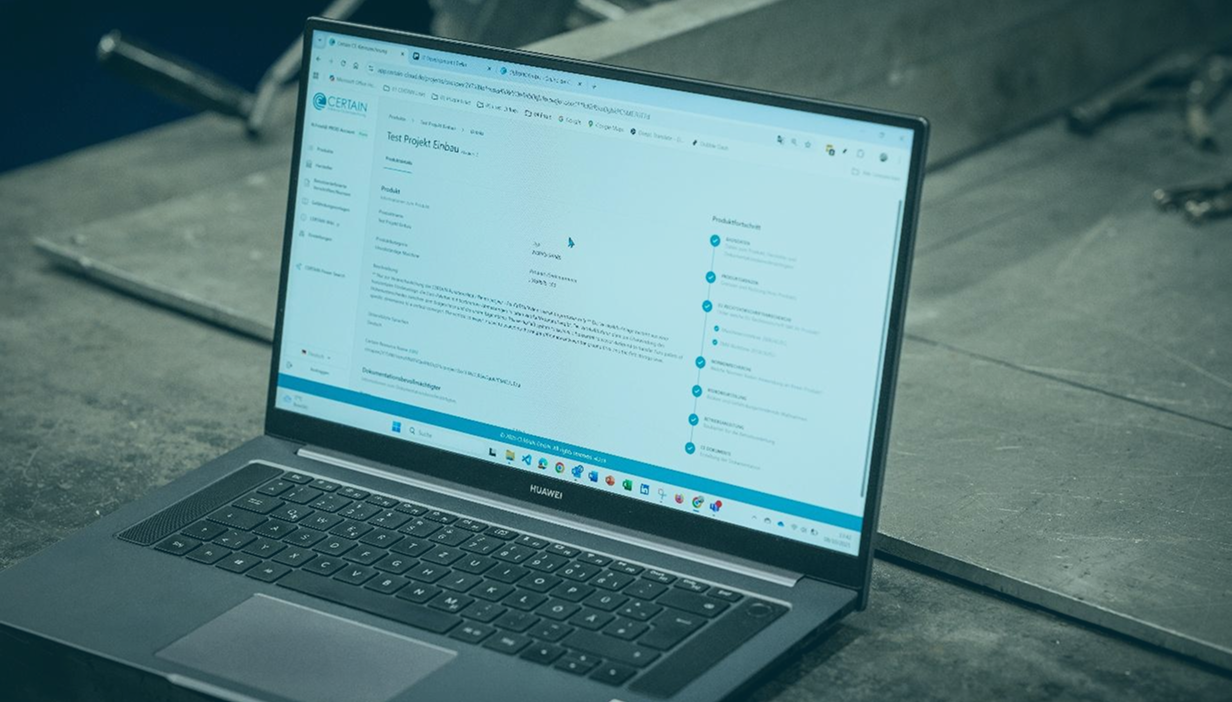
This is exactly where CERTAIN's instructions-for-use module comes in: a single source of truth, consistency between the risk assessment and the instructions, and end-to-end version control. This ensures that every set of instructions stays clearly assigned to its model and version, that changes remain traceable, and that a clean export for the paper version is available at all times. A formal obligation becomes an organized, auditable process.
Closing thoughts
Digital operating instructions are a genuine relief – if they are understood as a documentation and data process, not merely as "a PDF instead of a printout." The rules themselves are manageable; the risk lies in confusing "digital" with "paperless" and overlooking the availability, language, and assignment obligations. Anyone who switches early – and it is already possible today – will face no transition stress in 2027, just routine. And in the meantime, they benefit from advantages in versioning, multilingual support, and staying up to date.
Want to digitalize your operating instructions in compliance with the Machinery Regulation – versioned, multilingual, and available at all times? Get to know CERTAIN at certain-cloud.com.

Featured posts from our blog



Try CERTAIN free for 30 days now
Start today and see how easy your CE process can be. Explore the full range of features. No training. No payment details. No risk.
Start your free 30-day trial